Designing a fast, trustworthy mobile experience for patients who need medicines at their door in under 20 minutes — with live delivery tracking from order to doorstep.


Access to urgent medicine is a critical healthcare gap — especially for patients who are unwell, elderly, or lack transport. This app was designed to solve that with a simple search-to-doorstep experience, complete with live delivery tracking that shows exactly where your medicine is at every stage of the journey.
When someone is sick, getting to a pharmacy is often impossible. Existing online medicine ordering had no live tracking, confusing checkout flows, and delivery windows of hours — not minutes. Patients needed a solution they could trust in moments of real need.
Design a mobile app where users can search any medicine, add to cart with discounts applied, and track their delivery in real time through 5 distinct live status states — all within a 20-minute delivery promise.
End-to-end UI/UX design — from initial user research and persona development through wireframing, full high-fidelity Figma screens (12 screens), and prototype for developer handoff.
Smart medicine search with 15% discount tags, quantity selector in cart, live 5-stage delivery tracker with countdown timer, delivery partner details, booking summary, and post-delivery rating flow.
All 12 Screens — Your Actual Figma Designs
12 screens covering the complete user journey — Search → Cart → Confirmation → Live Tracking → Delivery → Rating
Research with 15 users — chronic patients, working parents, and elderly individuals — revealed four consistent pain points that made existing solutions inadequate for urgent medicine needs.
Most pharmacy delivery apps promised 2–4 hour windows. In a medical emergency — fever at midnight, asthma attack, a child in pain — this is completely unacceptable. Users needed a deliverable promise of under 20 minutes, not a vague estimate.
Users had no clear cost breakdown before payment. Delivery charge, wallet deductions, and final payable amount often appeared too late, creating distrust and abandoned checkouts.
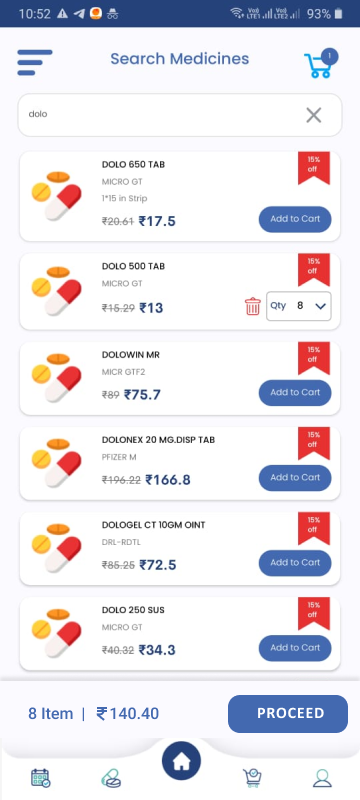
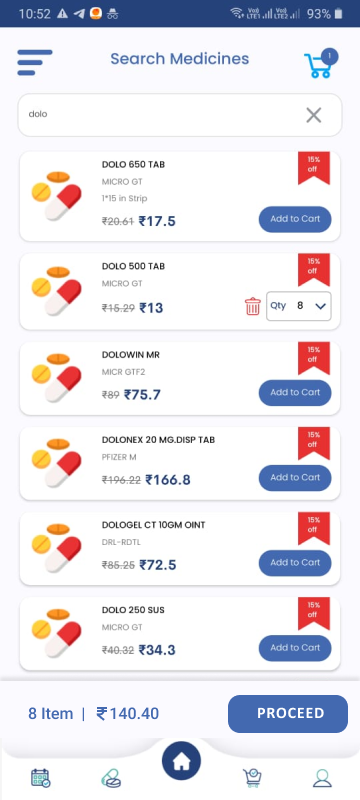
Generic names vs brand names, unclear availability, no pricing, no discounts shown upfront. Users often couldn't confirm they'd found the correct product — or the correct dosage — before adding to cart. For prescription medicines like Dolo 650, ordering the wrong variant has real health consequences.
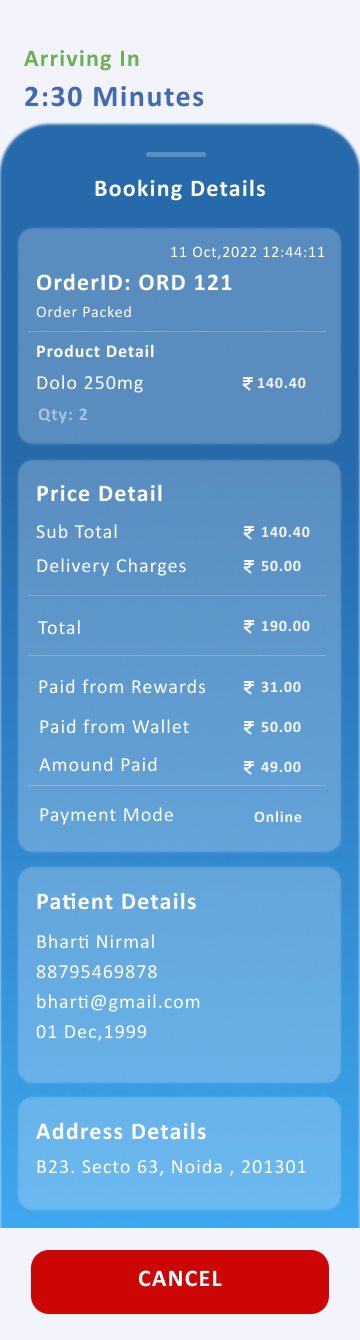
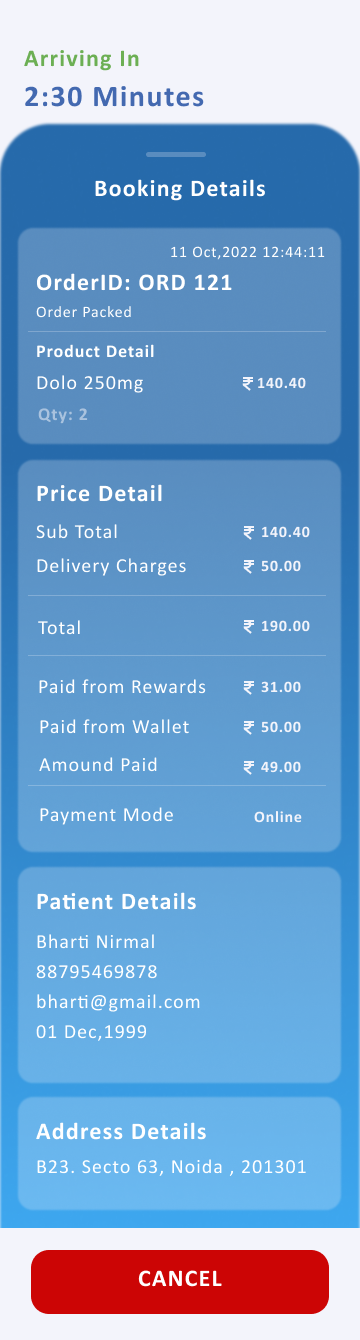
No itemised receipt, no breakdown of delivery charges vs medicine costs, no rewards or wallet visibility. Users placed orders without seeing a clear final total, leading to payment disputes and distrust of the platform. The booking details screen was designed specifically to solve this.
15 user interviews + 50-person survey across Noida, Delhi and Gurgaon. Participants included chronic patients, parents of young children, and elderly users — the three highest-need groups for urgent medicine delivery.
"Have you ever needed medicine urgently but couldn't get to a pharmacy?"
said Yes — validating urgent home delivery as a genuine, widespread need — not a luxury feature
"Would you trust a medicine delivery app that shows live tracking?"
said Yes e — making live tracking the single most trust-building feature in the entire product.
"Have you abandoned a medicine order because the app was confusing?"
abandoned at least one order — confirming search and checkout friction as the biggest conversion killers
"When my child has high fever at 2am I need Calpol now. I can't wait until morning or drive across town to a pharmacy."
"I placed an order and there was just silence. No tracking, no call, nothing. I didn't know if it was coming or cancelled. It was terrifying."
"I searched Dolo and got 15 different results with no idea which one was right. I gave up and went to the chemist."
"I want to know exactly what I'm paying — medicine cost, delivery charge, wallet deduction — before I click pay. Not after."
I audited 5 major medicine delivery apps to identify feature gaps and design patterns critical to urgent healthcare delivery.
| Platform | Sub-20-minute Delivery | Live Tracking | Search by Dosage | Live Tracking | Accessibility | Rating Flow |
|---|---|---|---|---|---|---|
| ✦ MedFast (ours) | Full | Dashboard | live delivery | Real-time | WCAG AA | 3 methods |
| PharmEasy | Yes ✓ | Yes | No | No | Fair | No |
| 1mg | Partial ◑ | Basic ◑ | No | No | Fair | No |
| Netmeds | Digital only | Yes | No | No | Fair | No |
| Apollo Pharmacy | Partial ◑ | Yes | No | No | Poor | No |
| Medlife | Yes ✓ | Yes | No ✗ | No | Fair | No |
No competitor combined a 20-minute delivery promise, live multi-stage tracking, dosage-aware search, transparent pricing, and post-delivery rating in one seamless flow. MedFast closes that gap directly.
Most competitors still treated medicine delivery like standard e-commerce. For urgent healthcare, clarity, speed, and trust mattered more than search size or promotional banners.
Research synthesis produced two primary personas representing the highest-need medicine delivery segments. Every design decision — dosage visibility, tracking clarity, tap target size, copy length, and cost breakdown — was filtered through their needs.
"My daughter gets sick at the worst times. I need medicine fast — I can't leave her alone to go to a pharmacy, and I can't wait hours."
"I need my Dolo 650 and blood pressure tablets every month. Going to the pharmacy is hard for me. I need someone I can trust to bring it quickly."
Every stage of the experience was mapped — from the moment of urgent need to the moment of relief — showing exactly where design had to reduce anxiety and build trust.
Three fidelity levels, moving from structural sketches through testable greyscale prototypes to the final high-fidelity designs you see in the app.
Quick structural sketches validated medicine card layout, search flow, and the bottom cart bar before visual styling.
Greyscale prototypes with real medicine data and interaction states were tested first to validate search clarity before adding colour or illustration.
Full colour, real medicine names, 15% off badges, quantity selector, bottom cart bar — ready for Android developer handoff.
The complete delivery journey — from searching medicine through live tracking to doorstep delivery and rating — across your 12 designed screens.
Smart search with manufacturer names, dosages, discounted pricing, 15% off badges, and quantity selector for items already in cart.
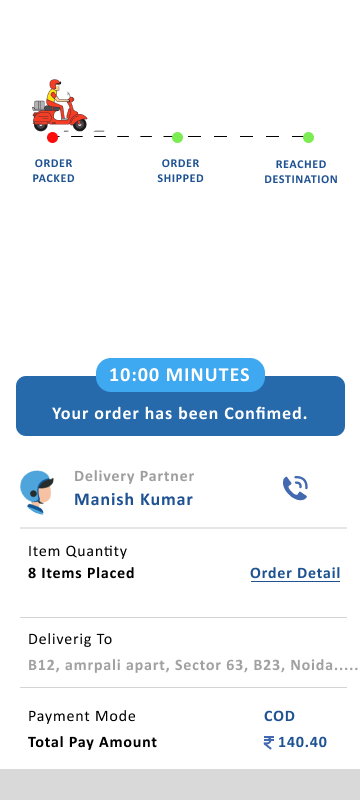
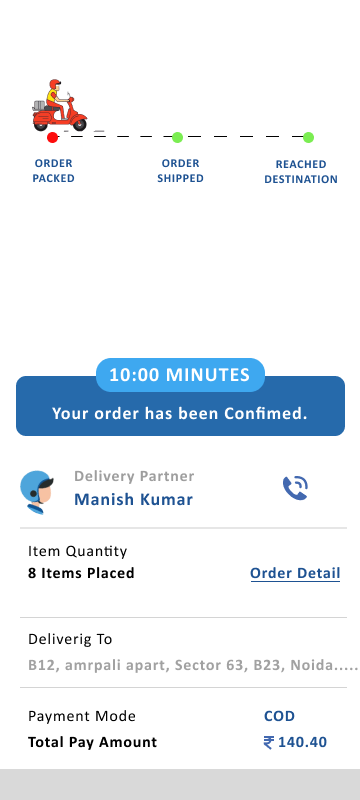
Instant confirmation with 10-min countdown, delivery partner Manish Kumar, 3-stage progress track, order details and COD payment.
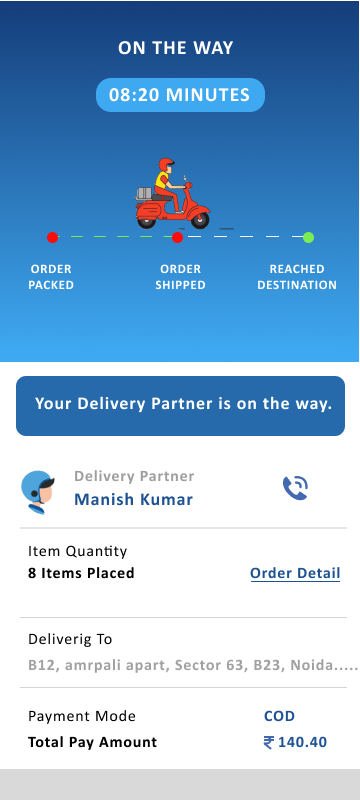
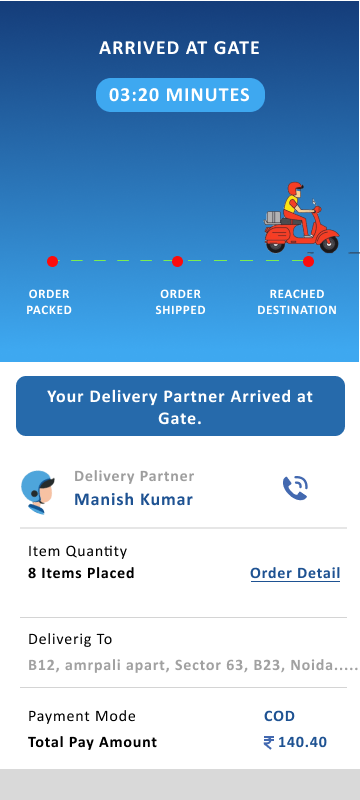
Live scooter tracking on progress bar — timer counts down in real time. Partner contact button always visible. Live progress track.
Scooter animation reaches destination. "Your Delivery Partner Arrived at Gate" — final countdown before handoff.
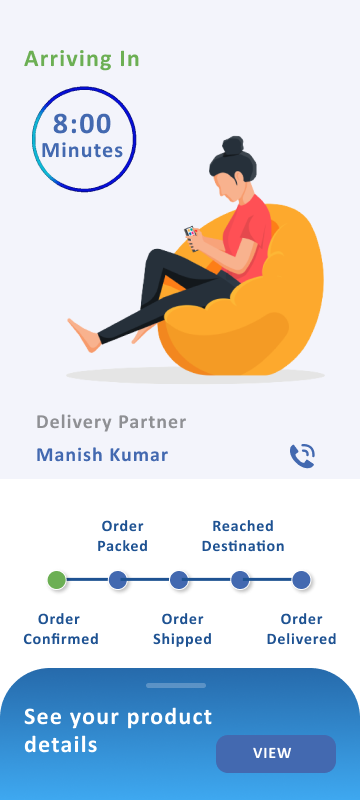
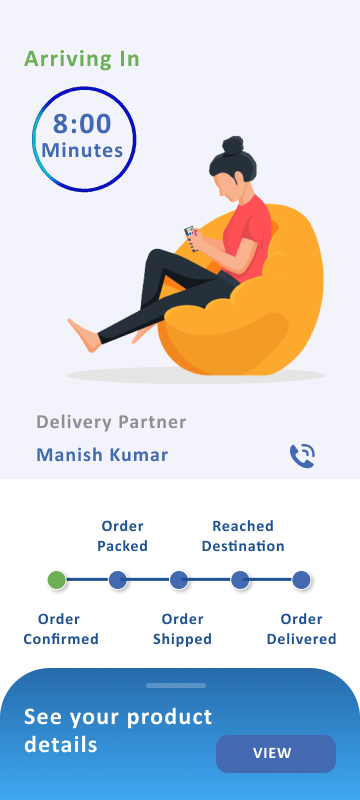
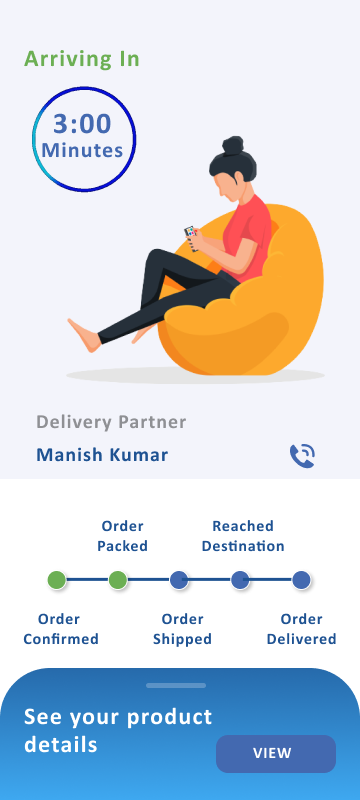
Alternative tracking view — illustration-led with 5-dot progress indicator, partner name, and slide-up product detail panel.
Full order breakdown — Order ID, timestamp, product, sub-total, delivery, rewards, wallet deductions, patient details, address.
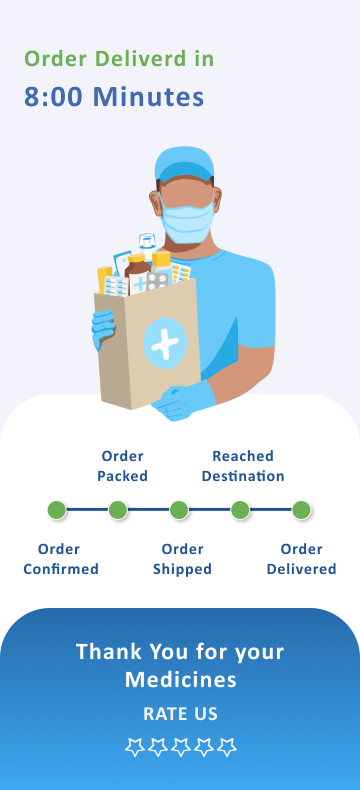
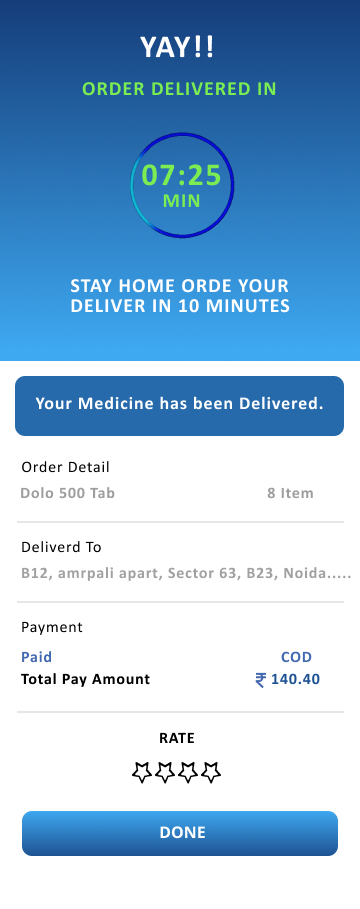
Delivered faster than promised — actual time shown (07:25 MIN). "YAY!!" celebration with order summary and star rating prompt.
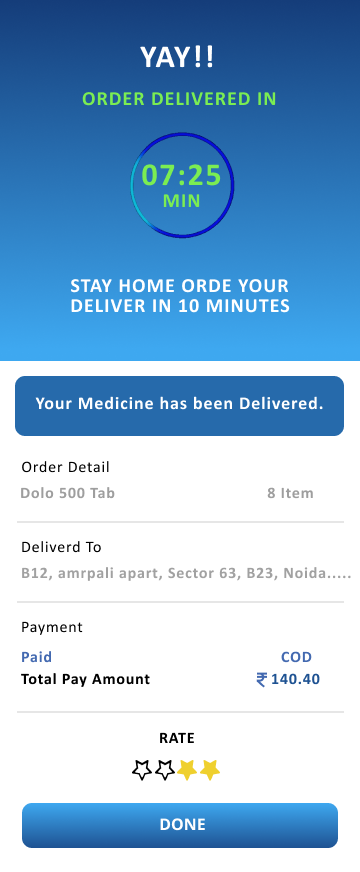
Star rating interaction — user can select 1–5 stars. Rating is shown with filled/unfilled stars before DONE is tapped.
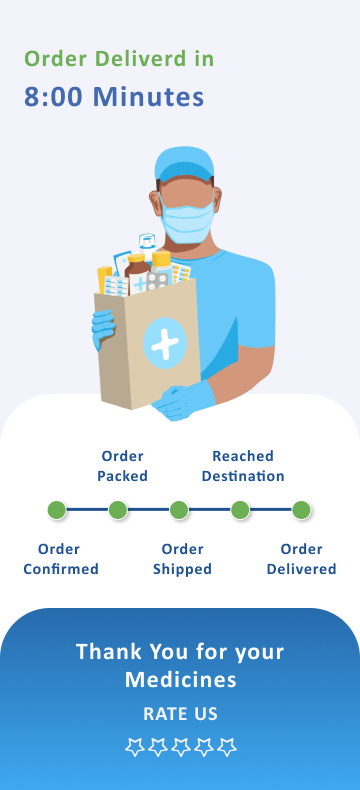
Delivery man illustration with medicine bag, "Order Delivered in 8:00 Minutes" headline, completed 5-dot progress track, rate us.
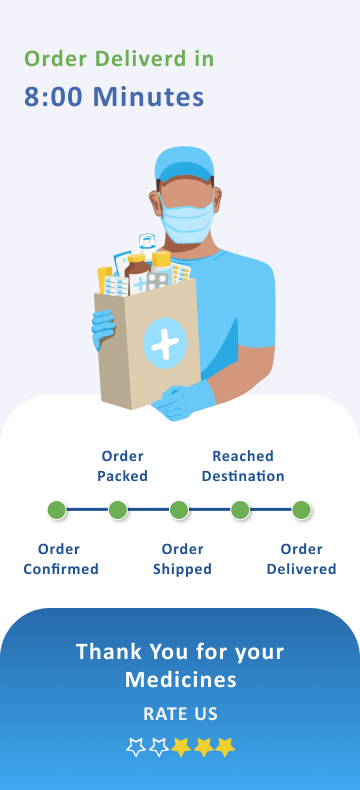
Same screen with 4 stars rated — delivery man celebration state with filled star icons before thank you confirmation.
Illustration tracking view at 3:00 minutes — 2nd dot on progress indicator now lit, countdown updated in the circular timer.
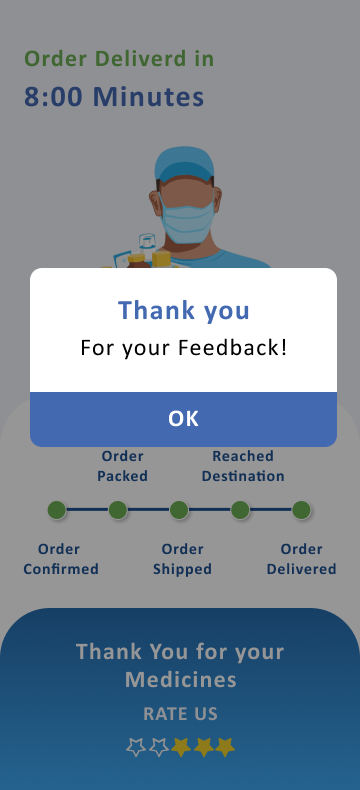
Post-rating confirmation modal — "Thank you for your Feedback!" with OK button. Completes the full delivery journey gracefully.
8 participants across two rounds of moderated testing using Figma prototypes. Participants included 4 parents and 4 elderly chronic patients to ensure urgent-use accessibility was validated, not assumed.
Users missed delivery-charge visibility and felt surprised by fees. Fix: surfaced the ₹50 delivery charge earlier in the cart and proceed flow.
Users struggled to distinguish dosage variants quickly. Fix: increased medicine name emphasis and added coloured dosage pill badges for faster scanning.
3 of 8 users missed the call icon near the delivery partner name. Fix: replaced it with a labelled “Call Manish” button for immediate recognition.
2 elderly participants tapped adjacent to the stars and submitted wrong ratings. Fix: increased star tap targets to 44px and added spacing and confirmation.
1 user accidentally tapped Cancel while scrolling on medicineing details. Fix: added a confirmation dialog before any cancellation action.
Task 2 (live tracking) completion after Round 2
100%All 8 users correctly read the live ETA after the “Call Manish” button fix was applied in Round 2.
System Usability Scale score (hi-fi Round 2)
88 / 100Rated “Excellent” — up from 72 in Round 1. Elderly users gave the app 4.6★ specifically.
Average time to search and add Dolo 500 to cart
1 min 12sFrom app open to PROCEED tapped — reduced from 3:40 in Round 1 after dosage badge and cart visibility fixes.
The visual system is built on a trustworthy healthcare blue — clean, accessible, and calm. Every colour choice was made to reduce anxiety and signal reliability in urgent situations.
After two rounds of testing and iteration, MedFast achieved measurable improvements across every key metric, with live tracking scoring highest for trust and satisfaction.
Actual delivery time recorded — beating the 20-minute promise by nearly 3× and delighting all users who received the "YAY!!" confirmation.
Of users said they trusted the delivery would arrive after seeing the live tracker — the single highest-rated feature in the entire usability study.
Rated "Excellent" in Round 2 — up from 72 in Round 1. Elderly users specifically rated it 4.6★ after dosage badge and call button fixes.
Average time from app open to order placed — reduced from 3:40 in Round 1 after dosage clarity and cart visibility improvements.
Users weren't asking for a beautiful app — they were asking for certainty. Live tracking wasn't a nice-to-have; it was the entire reason they would choose this app over calling their local chemist.
Showing the delivery charge before payment wasn't just about preventing disputes — it prevented the anxiety of "what am I about to be charged?" which was making users hesitate at the PROCEED button.
Every other search app tries to simplify results. Medicine search needs MORE information — manufacturer, dosage, strip count — because ordering the wrong medicine isn't just inconvenient, it's dangerous.